Native C++ command plane
WCPP, Crow and MongoDB hold channel intent, catalog state, policy and operational APIs while agents reconcile that intent on the media nodes.
CDN++ / Private Real-Time Media Infrastructure
CDN++ connects resilient contribution, Cisco high-speed networking, NVIDIA media processing, protected packaging, WCPP native C++ control, RAM/NVMe origin and HTTP/3 edge delivery as one observable operating path. HLS2SRT supplies the complementary no-re-encode gateway into SRT or UDP transport.
North-star architecture
CDN++ is designed as a private media cloud rather than a collection of unrelated transcoders and caches. Media moves through explicit high-throughput stages; commands, evidence and trust follow separate planes so no application UI becomes the source of operational truth.
Receive primary and backup satellite or IP feeds and establish an authenticated, observable source boundary.
SRT · RIST · UDP/RTP · HLSDemultiplex MPTS, create independent SPTS services and normalize program maps, clocks and timed metadata without an unnecessary re-encode.
PAT/PMT · PCR/PTS/DTS · SCTE-35Decode once, build the ABR ladder and process audio, captions, thumbnails and quality signals in supervised workers.
CUDA · NVENC · CPUCreate a common segment layer, publish HLS and DASH manifests and apply rights, encryption and advertising policy at explicit boundaries.
CMAF · HLS · DASH · DRMKeep live manifests and hot segments in RAM/NVMe, replicate origin state and tier longer retention into durable storage.
RAM · NVMe · DVR/VODAuthorize and route each request through the universal HTTP path, a private edge or an operator-assisted delivery profile.
NGINX · HTTP/3 · QUICDesign rule: media packets remain on the media plane; lifecycle commands, business state and telemetry travel through bounded control and observability interfaces.
Physical foundation / Documented configuration
The March 2023 CCI/Cisco bills of material describe two deliberately different server pools: GPU-rich C240 M7 media compute and RAM/NVMe- dense C220 M7 origin and cache. Redundant 100 GbE paths connect those roles without collapsing the complete platform into one machine type.
Cisco routing and redundant high-speed paths separate contribution, processing, origin, delivery and management traffic.
The processing pool pairs dual 40-core CPUs with three NVIDIA A16 cards per server for parallel media workloads.
High-memory, NVMe-dense nodes provide the physical foundation for hot origin, shield cache and delivery services.
They establish the class and scale of the physical platform. They do not replace profile-specific tests for streams per GPU, sustained network throughput, cache hit ratio, protected storage capacity, failure reserve, power or cooling. CDN++ publishes measured capacity only after those variables are fixed.
Controlled delivery chain
CDN++ is not an isolated cache. It is a vertically integrated operating path in which each layer has a defined responsibility for quality, protection, latency, routing and cost.
Receive SRT, UDP, HLS and MPEG-TS sources, probe their streams and select the service or program that belongs in the processing path.
Discover programs, preserve their elementary streams and fan an MPTS into isolated SPTS or UDP workers without re-encoding the contribution feed.
Use CUDA and NVENC for accelerated renditions or a libx264 CPU path, with one supervised processing lane for each selected program.
Create HLS master, video and audio playlists with MPEG-TS segments. CMAF, DASH, DRM and deterministic SCTE-35 splicing remain explicit integration tracks.
Expose media and catalog data through WCPP, keep hot objects close to the network path and select HTTP edge, operator-local or 5MBS delivery.
Transcoding fabric / Source reviewed
IMPLEMENTED AND RUNNINGThe implemented components now connect the complete working model: contribution gateway, program discovery, MPTS separation, per-program transcode workers, HLS packaging and WCPP media services. The diagram distinguishes that reviewed path from the SCTE-35 and SSAI work that still needs production hardening.
SRT caller/listener, managed UDP and HLS or MPEG-TS intake with stream and program inspection.
SRT · UDP · HLS · TSPAT/PMT-aware selection and per-program UDP fan-out keep video, audio and data streams together.
PROGRAM MAP · PID FILTERCUDA deinterlace and scale with NVENC, plus a separate libx264 path for three-rendition processing.
NVENC · CUDA · X264Master, variant and audio playlists use MPEG-TS segments with a reviewed six-second live profile.
MASTER · VIDEO · AUDIOThe C++ media API, catalog and controlled asset roots connect the packaged stream to edge-delivery policy.
API · ORIGIN · DELIVERYThe transcoding orchestration builds 720p and 540p H.264 renditions with CUDA filtering and NVIDIA NVENC while retaining the source video lane.
720P / 3 Mb/s · 540P / 1.6 Mb/sAn independent libavcodec and libavfilter implementation decodes once, splits the frame graph and encodes three x264 renditions.
1080P / 6.5 · 720P / 3.5 · 480P / 1.5 Mb/sOne demultiplexer discovers services and launches isolated encoder and packager workers, with restart and manifest-freshness logic handled by the supervisor variants.
PROGRAM DISCOVERY · WORKER CONTROLCue fixtures, scheduling, transport and HLS ad markers are present. Deterministic timestamp handling and single-owner playlist generation are still required before production splicing.
CUE CARRIAGE · AD+ POLICYThe implementation proves the architecture and its component responsibilities. These are the specific engineering gates that separate the reviewed prototype and deployment scripts from a supportable 24×7 transcoding service.
BossTV / CDN++ engineering lineage
CREATOR-OWNED SOFTWARE + INFRASTRUCTUREBossTV is the OTT application created by Diego Cardona—not a separate project in this portfolio. These published videos document the application across phone, tablet and television, together with the head-end and datacenter equipment he owns and operated for transcoding and media distribution.
The footage is presented here as operational evidence behind CDN++: application experience, media control, physical infrastructure and delivery engineering connected as one system.
Five published views—from mobile interaction to the living-room interface.
A short product view of the BossTV experience running on iPhone.
The same owned application experience presented for the larger iPad interface.
A viewer moves from the active channel into an in-video purchase workflow using a swipe interaction.
A product view of the BossTV television experience on an Android phone.
A longer walkthrough of the large-screen BossTV interface and navigation model.
The BossTV television experience running natively in an Android TV environment, including large-screen navigation and channel presentation.
A purchase workflow demonstrated on physical tvOS hardware, connecting the television experience with an actionable commerce path.
A detailed iPad demonstration of the BossTV interface, content discovery and viewing experience.
Owned equipment and operational environments used for transcoding, control and distribution.
Operational footage from the environment used to manage video services and media workflows.
Equipment racks and the physical head-end environment behind video acquisition and distribution.
A second infrastructure walkthrough showing the owned equipment, cabling and operational media environment.
A native HLS player written to exercise the delivery path end to end.
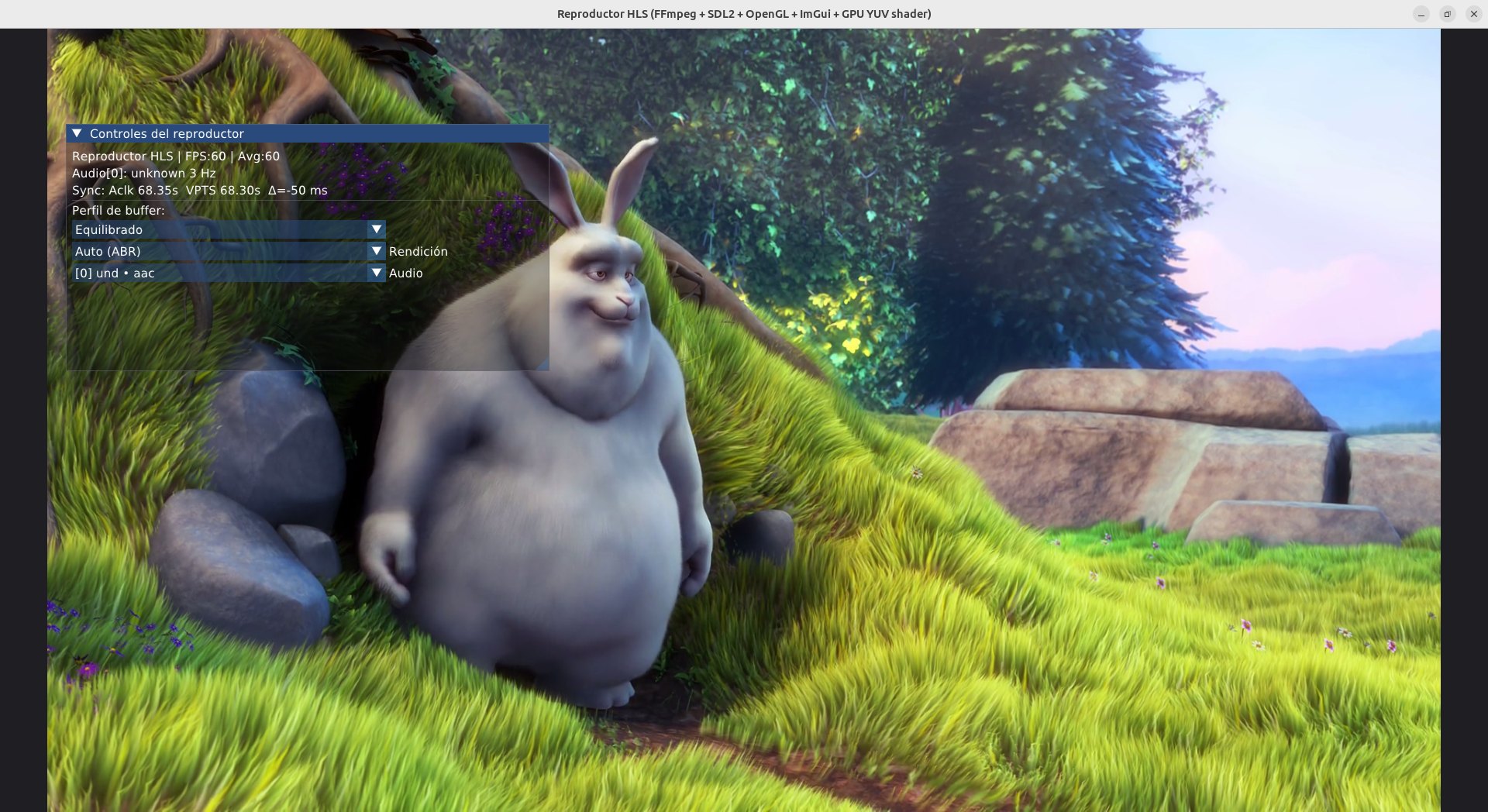
A delivery architecture is only as good as what the receiver can actually do with it. This C++20 player was written to test that side directly: it demuxes HLS with FFmpeg on a dedicated decode thread, uploads the YUV planes to the GPU and converts them to RGB in a GLSL shader, keeping I420, NV12 and NV21 on the fast path with a CPU sws_scale fallback for anything else.
Audio runs through SDL2 with an EMA-smoothed A/V clock, so the HUD reports the audio clock, the video PTS and the drift between them while the stream plays.
Proprietary SPICA software. The screenshot shows the player running an open test stream.
WCPP / CableKiller media service
SOURCE REVIEWED / IMPLEMENTED SERVICEThe WCPP media service is not a presentation mockup. It implements a multithreaded Crow service that connects media applications to a MongoDB program catalog, local artwork and HLS/MP4 assets. This validates the native backend direction for CDN++ while keeping a strict production boundary between application decisions and high-volume media-byte delivery.
MongoDB-backed station and airing collections expose schedule, title, TMS identifier and local artwork metadata to client applications.
Crow routes support station, time-window, title and program-ID queries plus bounded catalog retrieval and airing counts.
The service resolves local program images and delivers HLS playlists, MPEG-TS segments and MP4 assets from controlled filesystem roots.
A C++20 executable uses Crow's multithreaded server model and the MongoDB C++ driver as a compact backend for media applications.
Program catalog, application API, authorization and control-plane evolution.
Program routing, decode, filters, ABR encode, audio and quality-control work.
Efficient byte delivery, range handling, cache policy and protection of the application tier.
Persistent metadata, bounded process lifecycle, health reporting and recovery.
WCPP owns APIs and decisions. NGINX owns efficient segment delivery. C++/FFmpeg/NVENC workers own media processing. That separation keeps Crow out of bulk file copying while preserving a completely native operational stack.
/stationsList station records/airingsReturn a bounded airing catalog/airings/imagesResolve program artwork by TMS ID and start time/airings/by-station-timeQuery selected stations inside a time window/airings/by-timeQuery all airings inside a time window/airings/by-station/:stationIdRetrieve one station's airings/airings/searchSearch program titles/airings/tms/:tmsIdFind airings by program identifier/airings/count/:stationIdCount airings for one station/streaming/<path>Serve HLS, MPEG-TS and MP4 media/images/stations/<path>Serve locally managed program artwork/airings/:stationIdAdministrative station-airing cleanupThe reviewed source proves working routes, data access and media delivery. Before an Internet-facing deployment, the service still needs a formal security, streaming-efficiency and operations pass.
AD+ / Interactive monetization
PRODUCT ARCHITECTURE / IN DEVELOPMENTAD+ is the interactive advertising product architecture built on CDN++. It combines stream timing, publisher policy and efficient 3D assets so viewers can deliberately explore, respond or continue to commerce across Live and VOD.
Explore AD+SSAI may stitch media; the interactive layer stays in the publisher-controlled player.
SCTE-35 and application metadata identify an eligible moment without embedding viewer-interface logic in the media object.
AD+ evaluates publisher rules, consent state, device capability and campaign eligibility before resolving an experience manifest.
A compatible player retains playback authority while rendering an opt-in overlay, poll, offer or optimized glTF product asset.
Documented events connect impression, open, close, selection, device handoff and commerce outcomes to an auditable workflow.
Hybrid by design
A sparse VOD audience and a stadium-scale live audience are different network problems. CDN++ preserves a universal HTTP path while defining increasingly integrated options for operators.
The universal path for current televisions, phones, browsers and OTT applications. Every viewer receives an independent HLS or DASH flow from the closest available cache.
Place CDN++ nodes on a private interconnect or near an operator user plane so popular media avoids unnecessary public-transit distance and remains under a defined service boundary.
For dense audiences watching the same live rendition, a 5G SA operator may use 5MBS so one MBS session feeds multiple radio nodes and point-to-multipoint radio resources.
Content storage stays in the media edge. The user plane handles forwarding, tunneling, QoS and—when explicitly supported—MBS-session distribution. Exact vendor feature support must be confirmed for the operator's deployed product and software release.
Operator-integrated edge
The control plane decides what should happen. The application plane owns media and policy. The accelerated dataplane moves packets. The mobile core and RAN create network and radio fan-out.
Stores media objects, authorizes access, manages manifests, DRM, cache state and delivery policy.
Moves, classifies, encapsulates and—where the network design permits—replicates packets with minimal CPU copying.
Applies forwarding, tunneling, QoS and MBS-session treatment. It is not treated as a general-purpose content library.
Creates the real radio-efficiency gain through point-to-multipoint delivery and presents received media to the player workflow.
Reference live stream
At a 5 Mb/s reference bitrate, one three-second segment contains approximately 1.875 MB before protocol overhead. The bytes are not the hard part; repeating the same bytes across many independent subscriber and radio paths is.
Conceptual comparison. Actual capacity depends on renditions, service areas, radio configuration and implementation.
Demand-aware control
Count viewers by channel, rendition, service area, device capability and current network path—not only at national level.
Evaluate aggregate unicast traffic against the cost of establishing and operating an MBS bearer in that area.
Keep sparse audiences on unicast and move dense, synchronized audiences to the operator-assisted path when every prerequisite is met.
Fall back to unicast as demand, coverage or device support changes. Thresholds belong to operator policy and radio planning.
Carrier prerequisites
A private access circuit alone does not prove access to a mobile core. The production design requires confirmed interconnection, network functions, transport, RAN features and a compatible receiver path.
Technical basis
3GPP defines MB-SMF and MB-UPF as network functions. Public vendor portfolio pages describe user-plane product families, but they do not by themselves confirm MB-UPF support in a specific operator deployment. That confirmation belongs in engineering discovery.
Official overview of the 5MBS architecture and service model.
↗3GPP TS 23.247 archiveNormative architecture family for 5G multicast-broadcast services.
↗Ericsson Packet Core GatewayPublic product information for Ericsson's cloud-native user-plane gateway.
↗Ericsson Local Packet GatewayPublic product information for an integrated edge user-plane deployment.
↗Reference distribution model
The existing planning model compares a $0.004/GB CDN++ delivery rate with an illustrative $0.04/GB conventional-CDN benchmark. It is a scenario model, not a quotation or guaranteed saving.
HTTP/3 routing, caching and distributed edge delivery.
Comparison value only; not attributed to a named provider.
Before scope, geography, commitment and interconnection adjustments.
Every active viewer remains an independent network and radio flow.
The scale unit changes, but bearer, device and operator constraints remain.
Reference planning model only. Final pricing depends on committed traffic, geography, concurrency, peering and transit, redundancy, node placement and service scope. Contribution, transcoding, DRM, applications, dedicated connectivity and operator 5MBS integration are scoped separately. Decimal units are used.
Engineering roadmap
The roadmap starts with deterministic media behavior, turns the existing gateway and WCPP work into supportable services and only then expands across cells and regions. Each phase has an observable production outcome—not a feature-count milestone.
Version the input, output, clock, continuity, PSI/SI, SCTE-35 and error behavior expected from every channel.
Unify the HLS2SRT and SPTS/MPTS paths around one bounded C++ media core with soak, fault and conformance tests.
Schedule resilient ingest, GPU workers, packaging, hot origin and telemetry as one deployable failure domain with N+1 reserve.
Let WCPP define desired channel state while agents, security policy and observability prove actual state end to end.
Add active-active routing, regional recovery, operator integration and a future GPU pool when AV1 encoding becomes a product requirement.
Capability status
SPICA Networks engineering